Melanin and Mood Disorders
The Standard Time Act was implemented in 1918 in America to help soldiers in WW1 conserve their energy. This act established Daylight Saving Time, which involves setting clocks forward in the Spring to rise earlier, increasing exposure to sunlight, and then back in the Autumn, thus shortening a person's exposure to daylight. However, this ritual has disrupted the natural rhythm of the people participating. Daylight Saving Time is associated with an increase in heart attacks and strokes in the Spring, as well as an increase in Seasonal Affective Disorder in the Winter. Research shows that Black and Latino Women are more likely to experience chronic stress, depression, and Seasonal Affective Disorder than their racial counterparts. Behavioral disorders affect perception, further disrupting how a person functions and makes decisions. We’ve all heard the age-old joke of so-called White people having no rhythm, and many of us have seen them on the dance floor. But on a scientific level, are people with lower levels of melanin at a rhythmic disadvantage to those who have more?
To understand this, we must understand what melanin is and how it works in the body. So-called Black people are classified as the highest on the racial scale based on their concentration of melanin, and so-called White people are classified as the lowest. This variation leads to a physiological difference in how the systems in varying bodies function. Melanin is a directive particle found in all cells, and it is primarily secreted when the pineal gland spins. The rate at which the pineal gland spins is determined by the bond a person feels with their mother and father, or polarity. Melanin is highly adaptable and can be influenced by internal and external environmental factors. The body has its own way of regulating day and night. A day is distinguished by the time we are awake and absorbing light through our eyes. Night is when we are asleep, absorbing lower forms of light through our other senses. Abnormally speeding up or slowing down this process disrupts the innate relationship between melanin and a person's cells. Melanin concentrations in cells synchronize to influence the body's circadian rhythm. This rhythm is how the body maintains balance. In winter, many 9-to-5ers wake up before sunrise to get to work, where they sit in an office with no windows. These same people often travel home in darkness as well. A behavior that creates a routine of little to no exposure to natural sunlight during their workweek. Highly melanated or so-called Black people cannot have less than 2 hours of sun exposure a day, or else they will be at risk of serious health issues, resulting in lower melanin production and an unbalanced circadian rhythm.
The relationship between mental and behavioral health function is similar. They are both influenced by innate and external influences. When Black women practice the Daylight Saving Time ritual, they are at a higher risk for health and behavioral dysfunction due to their higher cell concentration of melanin. Manipulating the internal relationships of the organs, minerals, and enzymes that keep the body healthy can also alter the mental health of a highly melanated person. Those who live with seasonal or chronic depression are unable to adapt to systemic oppression and re-establish their internal and external balance, leading to long-term dysfunctional behavior and mood. Mood disorders can vary in frequency and duration. Oddly enough, symptoms of Manic Depression and Bipolar 1 Disorder resemble the personality of many corporate employees.
Symptoms of Bipolar I Disorder include:
Agitation or Euphoria
Decreased need for sleep
Racing thoughts
Increased productivity
Fast-paced or pressured speech
Abnormal increase in energy
Some occurrences of hypomania
Symptoms of Manic Bipolar I Disorder include:
When the above-stated symptoms become severe, functioning is impaired.
Often leading to hospitalization for hallucinations, paranoia, or disordered thoughts.
Symptoms of Bipolar II Disorder:
Inflated self-esteem
Shorter periods of sleep refresh the person, OR Insomnia
Excessive talking or pressured speech
Racing thoughts
Easily distracted or having difficulty concentrating
Risky behaviors
Focus on goal-directed behaviors or external or superficial rewards.
Depressed most of the day
Feelings of worthlessness or guilt
Low energy
Recurrent thoughts of suicidal ideation
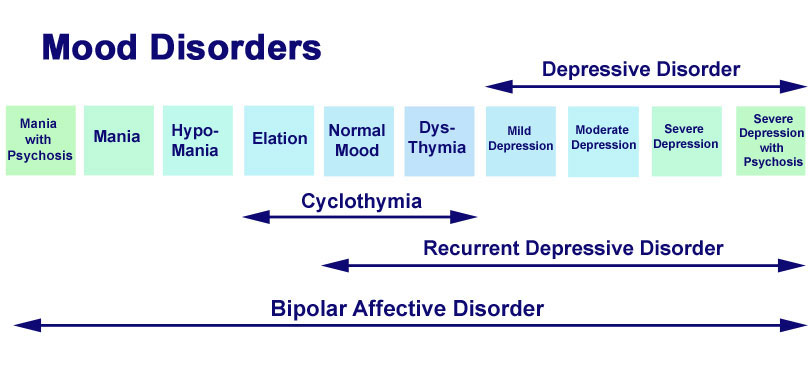
Symptoms of Bipolar III (cyclothymia):
Emotional ups and downs
Mild depression
A less consistent version of Bipolar I
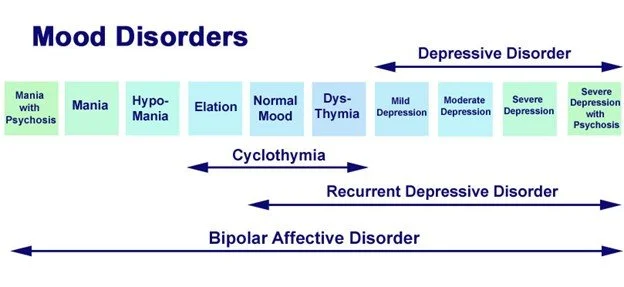
Mood Disorder Chart
Source: http://www.clinicaljunior.com/images/mood-disorders.jpg
Symptoms of Healthy Mood Management:
Consistent sleep patterns
Seasonal eating patterns
Stable energy
Not easily offended
Balanced perception of male and female influences
Regular self-care routine
Low desire to indulge in stimulants
Low desire to overeat
Unproblematic digestion or elimination
Stable weight management
Innately influenced to make decisions
Consistent exposure to fresh air and sunlight
Behavior is self-regulated
Regular water intake
References:
https://www.daylightsavingtime.info/dst-history
https://www.sciencedaily.com/releases/2018/05/180524174544.htm
https://youtu.be/7tKIJ2pH7v8?si=JX0G1Q6q-5BFiM1H
http://www.clinicaljunior.com/images/mood-disorders.jpg